
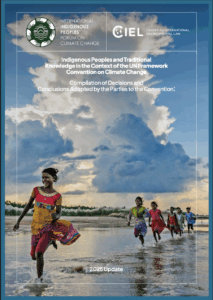
For decades, Indigenous Peoples have drawn on the wisdom of their Elders and knowledge keepers to understand and respond to the climate crisis. Their deep connection to the natural world provides unique knowledge systems that enabling them to understand, interpret, and react to the impacts of climate change. Their leadership has helped shape rights-based climate action, as reflected in the preamble of the Paris Agreement and ongoing UNFCCC negotiations.
CIEL and the International Indigenous Peoples Forum on Climate Change’s Indigenous Peoples and Traditional Knowledge in the Context of the UN Framework Convention on Climate Change lists all of the references to Indigenous Peoples and traditional knowledge adopted by the UNFCCC bodies up to the COP30— serving as a useful tool for all actors involved in climate policies and climate actions, including governments, private corporations, and financial institutions.
The IPCC recognizes that meaningful participation of Indigenous Peoples strengthens climate-resilient development by promoting locally appropriate and socially just solutions.
Recent rulings from the International Court of Justice and the Inter-American Court of Human Rights also reaffirmed States’ obligations to protect Indigenous rights, including Free, Prior, and Informed Consent (FPIC), in climate policy.
The compilation complements previous compilations published in 2018, 2019 and 2021.
Published on November 13, 2025