AI Energy Demand Boom Used to Promote CCS Expansion
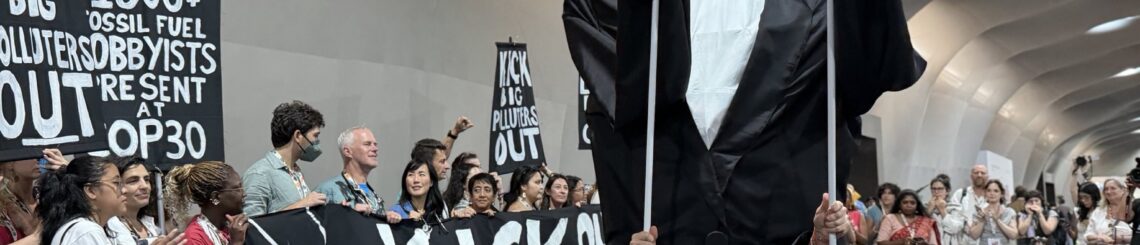
BELÉM, Brazil, November 17, 2025 — A new analysis conducted by the Center for International Environmental Law (CIEL) released today reveals that 531 Carbon Capture and Storage (CCS) lobbyists have gained access to the COP30 climate summit in Belém. [1]
CCS aims to trap carbon dioxide emissions and store them underground or utilize them in industrial processes and materials. In practice, it has a decades-long history of overpromising and under-delivering, it bolsters fossil fuel dependency, and it provides the industry with a lifeline, locking in new fossil projects for decades to come.
The CCS lobbyists have received more COP30 passes than 62 national delegations combined (526 delegates). These 62 delegations include 14 delegations from European Union countries.
They have also received more passes than any other single nation registered at COP30, except the host country, Brazil (899 delegates), and more passes than the national delegations from the G7 countries combined (481 delegates). This is the largest number of CCS lobbyists at a UN climate summit since CIEL started analysing conference registrations. The number of CCS lobbyists has increased for the third consecutive year. [2]
The fossil fuel industry and pro-carbon capture groups are using the boom in AI and the associated surge in energy demand to cement further fossil fuel expansion, using carbon capture promises to mask the devastating climate impact of fossil fuels.
Center for International Environmental Law Fossil Economy Director, Lili Fuhr, said:
“The fossil fuel industry has found in AI’s energy demand a new narrative to justify its survival — and in carbon capture, the perfect illusion. CCS cannot make fossil fuels ‘clean’; it just keeps them burning. It doesn’t curb emissions; it locks them in. When governments fall for the AI and carbon capture fairytale of the CCS lobbyists, they open a new escape hatch for the fossil fuel industry, undermine global climate efforts and delay the urgently needed phaseout of coal, oil, and gas. The world doesn’t need fossil-fueled tech-fantasies justifying business as usual for big polluters and Silicon Valley billionaires. It needs a future rooted in renewable energy, accountability, and justice, and a climate process with a robust conflict of interest policy.”
Of the 531 CCS lobbyists, 44 gained access to COP30 as part of national delegations, potentially gaining privileged access to the talks. Countries that brought CCS delegates include Brazil, Russia, Qatar, Oman, UAE, Libya, Kuwait, Bahrain, Japan, Honduras, Georgia, Azerbaijan and Algeria. [3]
Among the CCS lobbyists registered for COP30 are major fossil fuel companies including CNPC (21 lobbyists), Petrobras (19 lobbyists), Oxy (16 lobbyists), ExxonMobil (10 lobbyists), TotalEnergies (9 lobbyists) as well as CCS-promoting trade associations including Taiwan Carbon Capture Storage and Utilization Association (9 lobbyists), Global CCS Institute (5 lobbyists), Carbon Capture and Storage Association (4 lobbyists).
The CIEL analysis was released after the Kick Big Polluters Out Coalition reported that more than 1600 fossil fuel lobbyists gained access to this year’s climate talks.
Center for International Environmental Law Climate and Energy Director, Nikki Reisch, said: “What’s even more shocking than the fact that hundreds of CCS lobbyists and fossil fuel industry representatives are roaming COP’s halls is the fact that governments still invite them in. The continued presence of those who profit from the products heating the planet and making us sick is a reminder that reform of the UN climate talks is long overdue. It’s past time to show big polluters the door, to put conflict-of-interest rules in place, and to allow voting when consensus is blocked. The #COPWeNeed puts people, science, and the law at the center, not profits.”
The number of CCS lobbyists registered for the COP highlights the large amounts of energy and power the fossil fuel industry is investing to secure its future by selling the idea that governments and companies can ‘clean’ their use of coal, oil, and gas by capturing and ‘managing’ emissions, and thus don’t need to urgently phase out fossil fuels.
CCS has a decades-long history of overpromising and under-delivering, with projects frequently failing to meet published emission reduction targets.
- 88% of CCS projects fail, according to a 2024 article in Nature. [4]
- 90% of planned CSS projects in the power sector were never built, according to a 2021 article in Environmental Research. [5]
- CCS may be “highly economically damaging,” and cost at least USD 30 trillion more than a pathway based primarily on renewable energy, energy efficiency, and electrification, according to a report from Oxford University’s Smith School of Enterprise and the Environment. [6]
- CCS can also enable and worsen harm to communities already burdened by fossil fuel infrastructure with increased air pollution, according to an Energy and Environmental Science paper. [7]
- Capture rates rarely meet the 90% efficiency claimed by proponents. In fact, no existing project has consistently captured more than 80% of carbon, according to the Institute for Energy Economics and Financial Analysis.
Fossil fuel companies and pro-carbon capture trade groups are capitalizing on AI’s growing energy demand to justify a new wave of dirty fossil-fuelled power plants—often wrapped in the fig leaf of CCS to appeal to big tech companies’ desire to be seen as green.
Companies such as ExxonMobil and GE Vernova, which each have 10 registered CCS lobbyists at COP30, have promoted fossil fuel expansion to meet AI’s energy demand. ExxonMobil, for instance, claims that AI demand for reliable energy means that “as the largest producer of oil and natural gas in the United States, ExxonMobil is uniquely positioned to meet this challenge.” The company announced plans for a gas power plant equipped with CCS to supply “high-reliability electricity” to a data center.
For more information: CCS and AI: A New Escape Hatch and Vehicle for Misinformation for more details.
Expert Reactions
Institute for Energy Economics and Financial Analysis (IEEFA) Financial Analyst, Andrew Reid, said:
“It is unsurprising that CCS lobbyists are present in such force. CCS as a climate solution is unproven and presents significant technical and economic hurdles. It is in industry stakeholders’ interests to continue promoting it as a climate solution despite its challenges, and to pressure governments to provide enormous subsidies and policy support to mitigate their risks”.
Center for Biological Diversity Energy Justice Program Director & Senior Attorney, Jean Su, said:
“The influx of CCS lobbyists at COP30 shows how the AI industry is using the false promise of carbon capture as a lifeline for fossil fuels. AI is the love child of Big Tech and the fossil fuel industry. It’s critical that COP30 recognizes how the AI boom is threatening our global climate goals and acts swiftly to rein in this dirty industry.”
InfluenceMap Senior Analyst, Sofia Basheer, said:
“The oil and gas industry’s CCS playbook is clear: promote CCS to lock in fossil fuels and get the governments to fund it, all the while pushing back against meaningful climate regulation. Despite what it claims in its public campaigns, in the industry’s own words, CCS is unproven and cannot deliver. For the world, there is a real danger in focusing on this technology at the expense of credible and affordable solutions when the window for preventing catastrophic climate breakdown gets narrower each year.”
Enabled Emissions Campaign Co-founder, Holly Alpine, said:
“AI and carbon capture are being packaged as climate solutions, but most CCS today is being pumped back into the fossil fuel system to extract even more oil. AI is now optimizing and expanding those systems – deepening the industry’s dependence on technologies that exist to prolong its life. It’s a dangerous feedback loop of technology enabling additional emissions and eroding accountability.”
Media Contact at COP30 in Belém
Maria Frausto, Communications Director + 1 202 569-8107 (Signal and WhatsApp), [email protected]
Media Contact in CET (Geneva)
Niccolò Sarno, Media Relations Specialist + 41 22 506 80 37 (Signal and WhatsApp), [email protected]
Notes to Editors
[1] The CIEL dataset is available here to media organizations upon request, or write to [email protected]
Note on the methodology: The data is based on the official UNFCCC provisional list of COP30 registered participants, i.e., the delegates who have registered to attend the summit in person.CCS is also known as CCUS when it includes “Utilisation”. To be classified as a CC(U)S lobbyist, an organisation or company needs to have either been involved in a CC(U)S project, or have a track record of lobbying in favour of carbon capture technologies, or state that the purpose of the organisation includes the promotion of CC(U)S. This is based solely on publicly available verifiable information that includes: The company or organization’s website; The IEA CC(U)S project database; Description of lobbying activities by reputable news sources, academic papers or lobby tracking groups—this includes reporting by groups such as Influencemap; Relevant lobbying registers, e.g. issue areas and self-descriptions as declared in US federal lobbying database or EU Transparency Register. Many more representatives of other fossil fuel companies and their supporters registered in Belém may also be using COP30 to promote carbon capture and related technologies, such as Direct Air Capture.
[2] At COP29 in Azerbaijan, 480 CCS lobbyists registered, and at COP28 in Dubai, 475 CCS lobbyists registered. Party delegation numbers do not include ‘overflow’ passes (which are allocated by parties but provide less access than a party pass). One G7 country, the United States, did not register any national delegates.
[3] 44 of the 531 CCS lobbyists gained access as part of national delegations. A further 294 had national delegation ‘overflow’ passes, and the remaining 193 had other types of passes, the vast majority non-governmental.
[4] Source: 2024 article in Nature.
[5] Source: 2021 Article in Environmental Research.
[6] Source: 2023 report from Oxford University’s Smith School of Enterprise and the Environment.
[7] Source: 2019 Paper in Energy and Environmental Science.