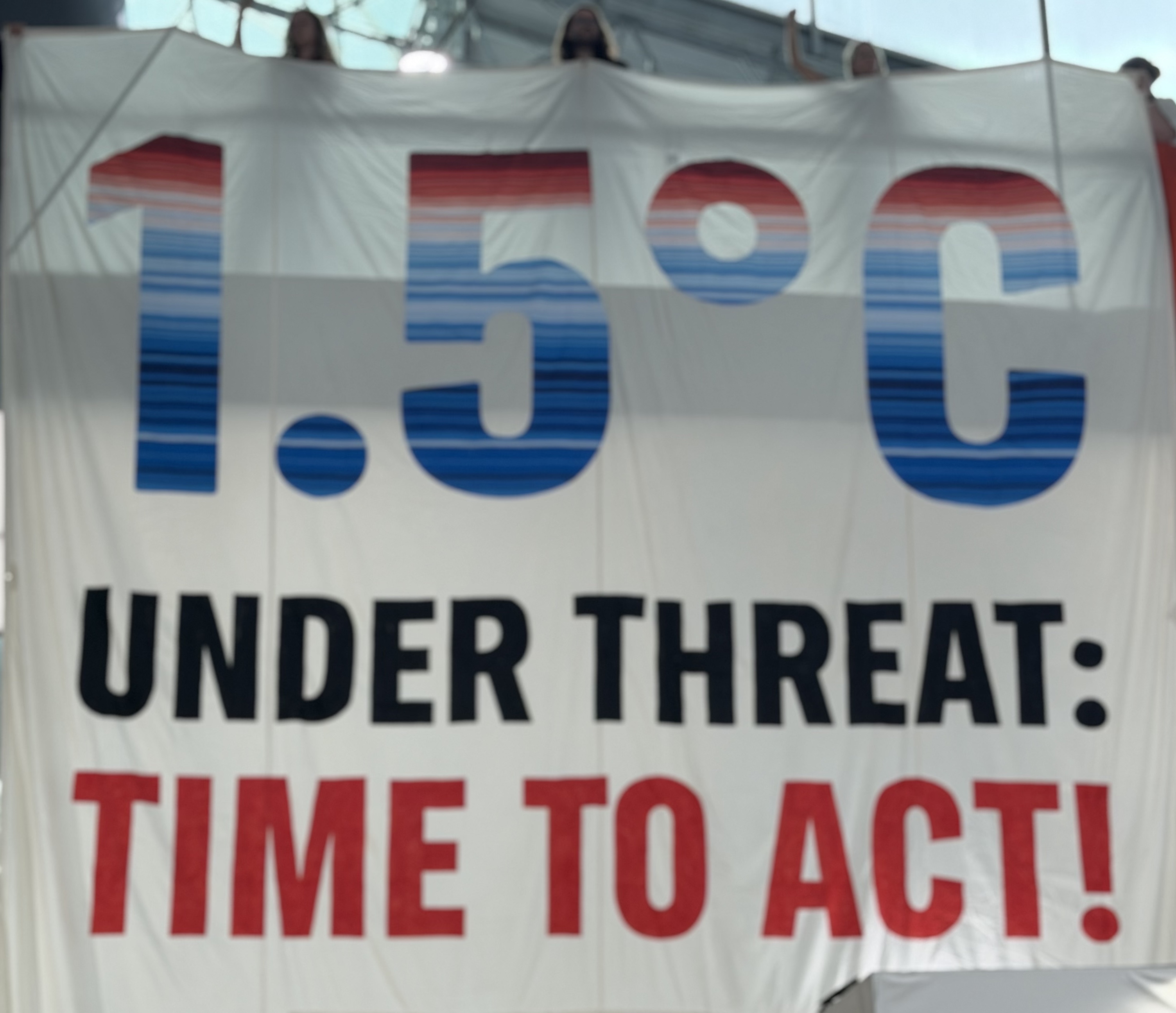
Approaching 1.5°C Is a Call to Double-down on Fossil Fuel Phase Out, Justice and Remedy, Not Gamble on Carbon Removal.
WASHINGTON, DC, September 2, 2026 — A UN Environment Programme (UNEP) report released today, “Limiting Overshoot,” warns of massive risks from rising temperatures, urges governments to stay focused on rapid emission cuts and equity, but fails to center a fast, fair, funded fossil fuel phase-out as the central strategy for governments to fulfill their legal obligations.
In response to the report, Lili Fuhr, Director of the Fossil Economy Program at the Center for International Environmental Law, released the following statement:
“Exceeding 1.5℃ and ‘managing’ overshoot is not a strategy. It is a moral and political failure. It locks us into irreversible harm, while those least responsible for the climate crisis are forced to bear its worst consequences. For many communities, ecosystems, and entire nations, 1.5C is a question of survival. Approaching it is a call to act faster and fairer, not gamble on false promises that only deepen the crisis.
Land- and ocean-based carbon removal technologies are often rebranded as ‘climate solutions’ but more accurately understood as geoengineering — and remain under a UN moratorium precisely because of their enormous, potentially devastating risks to biodiversity, human rights, and global climate stability. These include Direct Air Capture with Carbon Capture and Storage (DACCS), Bioenergy with CCS (BECCS), and ocean-based approaches.
Even the most optimistic and highly theoretical scaling of carbon removal would not deliver more than a few tenths of a degree this century, while locking us into decades of additional fossil fuel use, injustices, and harm. What’s more, these scenarios explicitly shift the burden from the historical polluters who have done most to cause the climate crisis onto the shoulders of countries that have done the least and yet will bear the worst consequences. Governments have a clear legal duty to stop climate harm at its source. The International Court of Justice has confirmed that states can be held legally responsible if they fail to regulate fossil fuel production and consumption. When proven solutions exist to cut emissions, turning to untested or speculative technologies instead contradicts the basic legal principles of prevention. And where there is a real risk that these technologies could cause serious, irreversible environmental damage, the precautionary principle requires governments to restrict or even prohibit their use.
The path forward requires centering remedy, accountability, and equity at the forefront of the conversation — not false promises or accounting tricks. The only way to minimize harm is a rapid, just phaseout of all fossil fuels, alongside the protection and restoration of ecosystems — not speculative technofixes that shift the burden onto future generations and vulnerable communities. Where harm has already been caused, those responsible must stop their destructive conduct and provide full reparation.
The technologies and knowledge to limit the global temperature rise already exist. Renewables are both the lowest-cost and quickest-to-deploy power generation, while agroecology and zero-waste approaches provide a pathway to transition away from petrochemicals. We must hold polluters accountable, empower frontline communities, and transform economies to ensure a just, equitable future where the temperature rise can be minimized, and communities are protected from the climate impacts we can no longer avoid. Real solutions are already here. What’s missing is the political will to choose them over false promises.”
###
Media Contact
Cate Bonacini, [email protected], +1-510-520-9109 (Signal and WhatsApp)