Media Brief
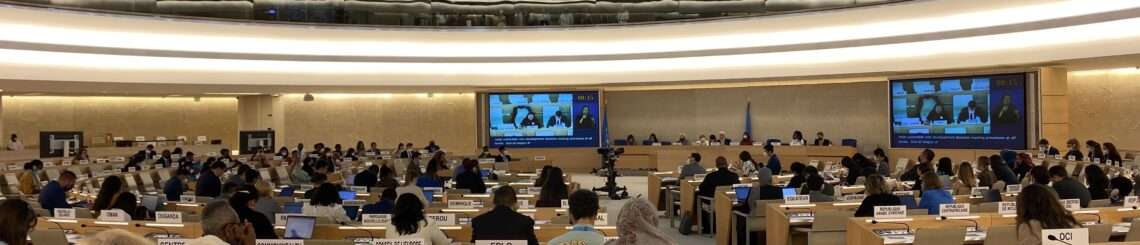
GENEVA, June 30, 2025 — The Center for International Environmental Law (CIEL) has applauded the groundbreaking report, The Imperative of Defossilizing our Economies, by the UN Special Rapporteur on the promotion and protection of human rights in the context of climate change, Elisa Morgera. Prof. Morgera presented the report to the UN Human Rights Council in Geneva on Monday, June 30, 2025.
This landmark report is the first UN report to focus exclusively on the human rights harms caused by fossil fuels and the legal obligations of States to prevent such harms.
The pivotal report calls for a rapid and just global phaseout of fossil fuels, delivering long-overdue recognition of what frontline communities have long understood: fossil fuels are at the heart of the climate crisis and a primary driver of human suffering.
Commenting on the report, Rebecca Brown, President & CEO of the Center for International Environmental Law, said:
“This landmark UN report is a stark and necessary call to action: fossil fuels and petrochemicals are not only driving the climate crisis and harming human and ecosystem health, they are also fueling widespread human rights violations across generations and communities. The science is settled, the legal imperative is urgent, and the moral case for a rapid, funded, just, and complete phaseout of fossil fuels across all sectors of our global economy is undeniable. CIEL stands with frontline communities, Indigenous Peoples, and all those demanding justice.
We cannot afford to waste precious time on speculative technologies such as geoengineering schemes, and proven-to-fail distractions like carbon capture that merely prolong fossil fuel dependence. The imperative — scientific, legal, and moral — is clear: we must end the extraction, expansion, and use of all fossil fuels, not just manage their emissions. This includes protecting our marine environments from the devastating impacts of offshore drilling, plastic pollution, petrochemical expansion, carbon injection, and geoengineering interventions that threaten ocean health.
The upcoming Advisory Opinions at the International Court of Justice and the Inter-American Court of Human Rights are poised to clarify States’ obligations under international law to address climate change and the legal consequences of failing to meet these obligations. This means that States must stop harmful conduct at its source — by keeping fossil fuels in the ground to ensure a future where human rights and the environment are protected for all.”
Media contact
Niccolò Sarno, CIEL Global Media Relations: [email protected] + 41 22 506 80 37
Report Highlights
Fossil Fuels Cause Widespread Human Rights Harm
“In addition to climate-related human rights impacts, each stage of the fossil fuel life cycle entails significant and pervasive risks and harm for the rights to life, health and an adequate standard of living and for cultural rights throughout the whole of people’s lives and across different generations. Such harm is due to toxic pollution and biodiversity loss, impacting the right to a healthy environment and further exacerbating climate change impacts.” (para. 16)
Fossil fuels (coal, oil, gas) are responsible for 81–91 percent of historic anthropogenic carbon dioxide emissions, according to the 2023 IPCC Climate Change Synthesis Report. They are also key drivers of biodiversity loss, toxic pollution, and systemic inequalities. The report documents how fossil fuel operations disproportionately impact Indigenous Peoples, people of African descent, peasants, children, and marginalized communities — contributing to displacement, loss of livelihoods, pollution, disease and premature death, destruction of cultural heritage, and food and water insecurity.
“Fossil fuel activities are often clustered in ‘sacrifice zones’ where communities already in disproportionately vulnerable situations because of poverty, marginalization and racialization are at high risk of chronic respiratory, cardiac and reproductive conditions, and cancers” (para. 17)
The report also underscores the harm caused by offshore fossil fuel operations to fisheries and marine ecosystems that store carbon, with direct consequences for food, health, livelihoods, and cultural rights.
The Path Forward: Keep Fossil Fuels in the Ground and Remedy Harm
To protect fundamental rights, the world must stop new fossil fuel development and begin an urgent, science-based phaseout.
“Most of the world’s proven fossil fuel reserves must be left unburned: at least 60 per cent of oil and gas reserves and 90 per cent of coal reserves must remain unextracted; Fossil fuel supply must decline by 55 per cent by 2035 on 2023 levels; … No new fossil fuel-burning power plants should be built… Fossil fuel infrastructure should be retired before the end of its technical life.” (para. 13)
Continued expansion not only drives climate chaos but also violates the rights of current and future generations. The report emphasizes the need for a just transition that centers workers, communities most affected by climate change, Indigenous Peoples, people of African descent, peasants, women, children, and youth.
For an effective phaseout of fossil fuels, the report outlines key steps, calling upon States:
“(a) To prohibit new fossil fuel exploration and exploitation, as well as any expansion of fossil fuel infrastructure;
(b) To revoke licences for existing fossil fuel exploration and exploitation, including for captive and on-grid coal plants;
(c) To strictly regulate the import and export of fossil fuels;
(d) To prohibit the abandonment of fossil fuel infrastructure without remediation, requiring financial guarantees to cover costs for the environmental management of facility closure and subsequent phases, including regarding extraterritorial impacts;
(e) To clarify how energy services will be maintained and improved through other sources, prioritizing the energy needs of rights holders in vulnerable situations domestically and abroad.” (para. 58)
The report stresses the imperative of providing effective remedies for fossil fuels-related harm and explains how this would include guarantees of non-repetition, rehabilitation, compensation, satisfaction, and restitution.
“Any remedy should be co-developed with affected human rights holders, in accordance with their assessments of impacts and their holistic evaluations of loss and damage experienced, taking into account intersectionality and historical and structural discrimination, with guarantees of access to justice and effective remedy.” (para. 75)
Defossilizing Knowledge and Protecting the Right to Information, Education and Science from Fossil Fuel Industry Influence
The report lays bare the fossil fuel industry’s decades-long strategy of obstruction and disinformation, including attacks on scientists and environmental human rights defenders, and manipulation of public discourse.
“Instead of acting on this knowledge to prevent harm, fossil fuel companies have counterfeited climate science, buying credibility for fossil fuel-influenced research through university affiliations, while intimidating independent climate scientists and manufacturing doubts regarding their science. These companies have also been responsible for attacks against environmental human rights defenders, including judicial harassment tactics, to silence, intimidate or punish their critics.” (para. 38)
It also highlights how Big Tech platforms and advertising firms amplify misinformation led by fossil fuel companies, misleading the public and undermining democratic accountability.
“… fossil fuels advertisements have for decades shaped public perceptions by downplaying human rights impacts and emphasizing the role of fossil fuel products in economic growth and modern life.” (para. 40)
The report calls on States to “defossilize information systems” to protect the public from fossil fuel influence, including by:
“…Criminaliz[ing] misinformation and misrepresentation (greenwashing) by the fossil fuel industry, including failure to disclose corporate lobbying activities or to provide remedies for harm;” (para. 73)
The UN Special Rapporteur further points to the responsibility of international organizations and specifically highlights the need for
“[t]he United Nations Framework Convention on Climate Change secretariat and UNEP [to] develop transparent and accountable systems against undue influence by fossil fuel corporate lobbying and conflict of interests” (para. 90)
Stop Public Funding for Harm
Despite record profits, fossil fuel companies continue to receive massive public subsidies while externalizing health and environmental costs. The report makes it clear that direct and indirect subsidies to fossil fuels are incompatible with States’ human rights obligations.
“These subsidies are contrary to States’ obligation to devote the maximum available resources to progressively fulfil human rights.” (para. 32)
The report highlights the devastating effects of Investor-State Dispute Settlement (ISDS) mechanisms, used by fossil fuel companies to block or delay public interest regulations.
“What is more, multinational fossil fuel companies benefit from undue protection against climate action under bilateral investment agreements, contracts, and investor-State dispute settlement. … This means that States and taxpayers are paying fossil fuel companies compensation for trying to take measures to advance the just transition, diverting public funding from investments in renewables, adaptation and workers’ social protection.” (para. 35)
The report calls for the systematic termination of outdated investment treaties and the creation of a new international investment governance system designed to support effective action to tackle the planetary crises.
Petrochemicals and Plastics: A Hidden Driver of Fossil Dependence
The report clearly warns about the growing role of plastics and petrochemicals in locking in fossil fuel dependence across economies:
“The increasing production of plastics and petrochemicals is embedding dependence on fossil fuels in our economies within and beyond the energy sector, regardless of continued contributions to climate change and other human rights harm. In addition, plastics and petrochemicals cause their own host of severe human rights impacts, worsening climate change, biodiversity loss and toxic pollution, and thereby compounding negative impacts on the rights to life, health, an adequate standard of living and a healthy environment and on cultural rights” (para. 25)
Plastics are projected to account for 50 percent of global oil demand by 2050. Their production worsens pollution, threatens food and water systems, and causes intergenerational harm to health. These sectors pose a major obstacle to a defossilized, decarbonized, and detoxified future. Petrochemicals used in agriculture are also a major driver of fossil fuel expansion.
“Petrochemicals used in agriculture are projected to account for more than two thirds of global oil demand growth by 2026, and for more than half of all oil usage by 2050. Synthetic nitrogen fertilizers, in particular, are driving fossil fuel expansion. Due to interactions with soil, they release nitrous oxide (N2O), which is nearly 300 times as harmful to the climate as carbon dioxide and accounts for 2.1 per cent of global greenhouse gas emissions — more than commercial aviation. In addition, agrochemicals cause soil acidification, inland and coastal water eutrophication, and impacts on regional air quality, with further loss of nature’s capacity to regulate the climate system.” (para. 28)
The report highlights the importance of a Global Plastics Treaty that includes legally binding measures to cut production, reduce harm, and urges States to address false claims about “advanced plastics recycling.”
“In the ongoing plastics treaty negotiations, States should agree… [t]o restrict primary production of plastics and exports of plastic waste … [t]o address false claims about advanced plastics recycling that contribute to lock-in.” (para 80)
The Global Plastics Treaty negotiations represent a critical opportunity to prevent fossil fuel lock-in and the human rights harms associated with plastics and petrochemicals. States should restrict the primary production of plastics and exports of plastic waste. They should also ensure financial compensation for affected communities and informal waste workers.
The Time for Action Is Now
This report is a legal, scientific, and moral wake-up call. It confirms what communities have said for decades: fossil fuels violate human rights, and their continued use is indefensible.
“The interlinked, intergenerational, severe and widespread human rights impacts of the fossil fuel life cycle, coupled with six decades of climate obstruction, compel urgent defossilization of our whole economies, for a just transition that is effective, human rights based and transformative in protecting the climate, nature, water and food on which life and health for present and future generations depend.” (Summary para.)