
Advancing Climate Justice at the International Court of Justice
We live in a climate emergency. Extreme weather events—fires, heatwaves, floods, hurricanes— and other climate impacts, such as sea level rise and desertification, are increasingly devastating people’s rights, lives and livelihoods globally.
For far too long, the States most responsible for the climate crisis have failed to lead in addressing it and paying up for the harm they have caused. Now a unique opportunity to change this is upon us.
Despite decades of awareness about the grave risks and impacts of the climate crisis, there is an enormous gap between States’ climate policies and what science and justice demand to avert climate catastrophe. In July, 2025, the International Court of Justice (ICJ) issued a landmark opinion affirming that States have a binding legal duty to prevent climate harm and protect human rights from the impacts of climate change. The Advisory Opinion declares the era of fossil fuel impunity over and sets a new global standard for urgent action and accountability on climate justice.
In its long-awaited ruling on States’ legal obligations regarding climate change, the Court defined what justice means in the face of climate breakdown — ruling that countries must act with urgency, cooperate in good faith, and repair the damage already done— setting the stage for accountability and real action worldwide.
This Opinion will guide climate litigation at the local, regional, and national courts, and provide a foundation for climate policymaking, grounding local legislation and global negotiations in legal obligation.
CIEL engaged in the ICJ process through legal submissions, State briefings, providing input to State submissions, and coordinating with global partners.
Why was the ICJ Involved?
On 29 March 2023, the General Assembly of the United Nations unanimously adopted a resolution requesting the ICJ to give an advisory opinion on “the obligations of States in respect of climate change.”
Who Initiated the ICJ Request?
The ICJ climate advisory proceedings resulted from the relentless efforts of Pacific Island students, other Pacific leaders and organizations, global campaigners, and the leadership of many States, especially Vanuatu and a core group of nations including Angola, Antigua and Barbuda, Bangladesh, Costa Rica, Federated States of Micronesia, Germany, Liechtenstein, Morocco, Mozambique, New Zealand, Portugal, Romania, Samoa, Sierra Leone, Singapore, Uganda, and Viet Nam.
At a time when climate devastation is causing pervasive harm across the world, the ICJ process— alongside the advisory opinions issued by the InterAmerican Court of Human Rights and the International Tribunal for the Law of the Sea—offers a once-in-a-generation opportunity to clarify States’ obligations under multiple sources of international law, uplift climate justice, and raise ambition.
What Is an Advisory Opinion of the ICJ?
An advisory opinion (AO) of the ICJ is a legal clarification provided by the Court to the UN or a specialized agency on points and questions of law , in accordance with Article 96 of the UN Charter. AOs are considered authoritative interpretations of international law, carry significant legal weight, and are often considered instruments “of preventive diplomacy.”
What were the Questions Before the ICJ?
- What are the obligations of States under international law in relation to climate change?
- What are the legal consequences when States do not meet or breach these obligations?
Put simply, States wanted to know what international law has to say about what they are required to do about climate change.
Why is This Action Being Taken?
The scientific evidence is clear that the climate crisis has existential stakes. Climate impacts are harming (and will continue to harm) people, their livelihoods, and ecosystems worldwide. States have duties under different international laws, like human rights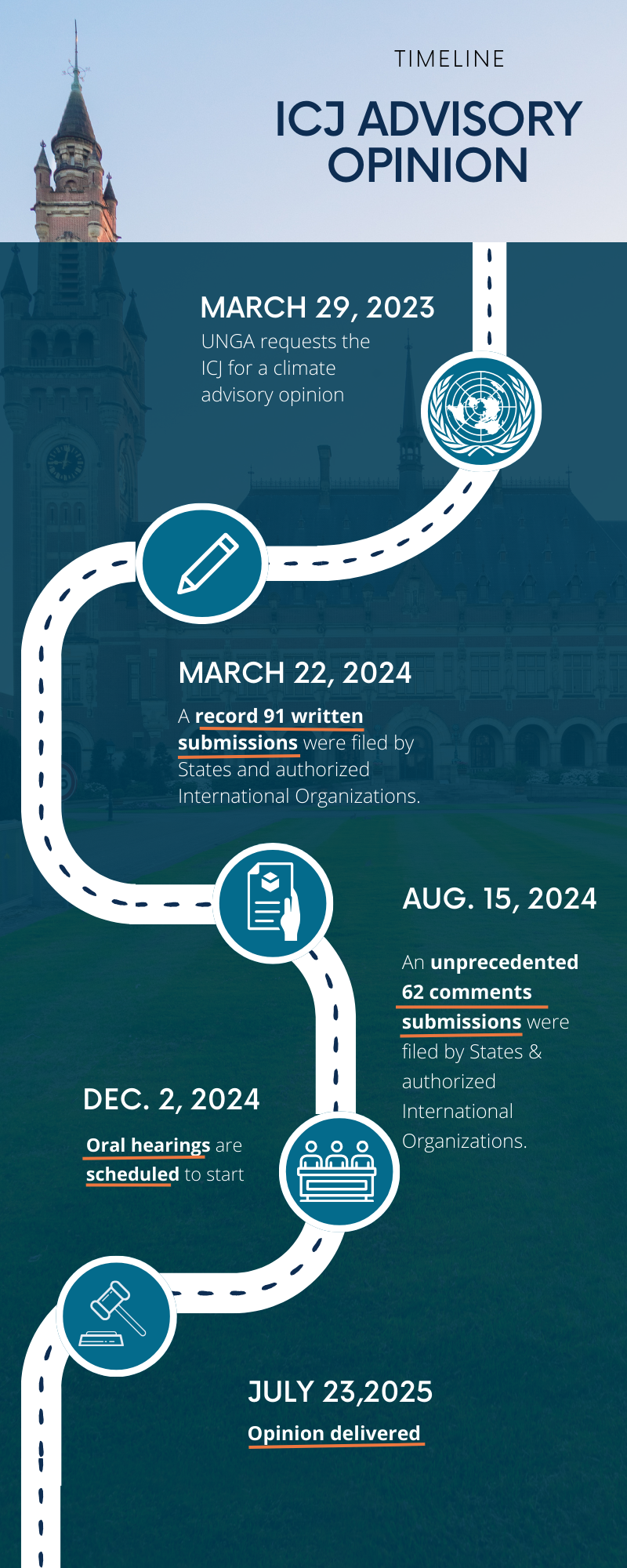 law and the Law of the Sea, to prevent, reduce and remedy climate harm, and there are legal consequences for failing to do so. At the heart of this action is “the desire to strengthen collective action on climate justice.” Legal clarity from the International Court of Justice – the UN’s highest judicial organ may help unlock climate ambition and justice.
Timeline of the process?
- March 29, 2023: UNGA Resolution Adopted requesting the ICJ for a climate advisory opinion
- March 22, 2024: A record 91 submissions in the first phase of the written proceedings were filed by States and authorized International Organizations.
- August 15, 2024: States and authorized international organizations filed an unprecedented 62 submissions in the comments written phase.
- December 2-13, 2024: Oral hearings take place in The Hague.
- July 23, 2025: the Court delivered its advisory opinion
What Could a Strong Advisory Opinion Mean for People Impacted by Climate Change?
We need urgent action to tackle the climate emergency. The law is one of the most powerful tools we have to change the system and hold governments and companies to account. Clarification of the law by the ICJ in relation to climate change may pave the way to bring States to Court if they do not protect people and the planet from the impacts of the climate crisis or for causing the crisis in the first place.
The ICJ AO will likely influence national and regional courts’ interpretation of State duties and the outcome of pending and future cases, inform climate action, and may help cut through the political inertia that has plagued climate negotiations and national-level climate action. The proceedings will also force an airing of government positions on key legal questions, providing an important foundation to make polluters pay.
How Is CIEL Involved?
CIEL has engaged in this Advisory Opinion at the International Court of Justice in multiple ways, including by making legal submissions under ICJ Practice Directive XII; providing legal input to States and organizing multiple, closed-door State briefings on key substantive and strategic issues; working closely with partners across the world to build political and public support for, and momentum behind the ICJ AO; and collaborating with other civil society organizations to call for fairer procedural rules.
Daily Debriefs from the Hearings
To socialize the technical and legal oral arguments by States and international organizations, a small team coordinated by legal experts from World Youth for Climate Justice and CIEL carries out a top-line analysis of the arguments at the end of each day of the hearing.
Opinion Reading Debrief
To unpack the delivery of the Climate Advisory Opinion, a small team coordinated by legal experts from World Youth for Climate Justice and CIEL carried out a top-line analysis of the key themes in the AO and initial reactions.
Some relevant resources:
Latest resources
- Leveraging the ICJ Climate Ruling at COP30 to Unlock Ambition and Advance Accountability: A Pocket Guide for Negotiators and Allies
- The Obligations of States in Confronting Climate Change: What Does the Advisory Opinion Mean for Loss and Damage?
Written Submissions
Under ICJ Practice Directive XII, CIEL submitted a collated brief outlining State obligations and the legal consequences of their breach, examining the legal framework across four key areas:
- Applicable Law;
- Reparations for Climate Harm ;
- Obligations to Phase Out Fossil Fuels;
- Rights of Future Generations.
Unpacking the proceedings
- Climate Justice Proceedings at the ICJ: Top Arguments to Watch For in the Written Submissions
- Daily Debriefs Compendium
Communications
Blog and statement:
-
- The Verdict Is In: To Comply with the Law, COP30 Must Deliver
- Movement Lawerying Matters
- From the Court to the Treaty Negotiations: How the ICJ ruling Could Strengthen the Global Plastics Treaty
- The Era of Climate Impunity is Over— By Order of the World’s Highest Court
- The World’s Highest Court Can’t Ignore the World’s Biggest Climate Culprit: Fossil Fuels
- A Defining Moment for Climate Justice: What to Watch For in the ICJ Climate Ruling
- Expert Availability: World Court to Deliver Landmark Ruling on Climate Change and States’ Obligations
- Tides of Justice: The Climate Advisory Opinions and Legal Duties to Make the Ocean Fossil-Free
- “Will The Law Rise to Meet Its Highest Calling?” The Historic ICJ Climate Hearings on Climate Justice
- Forthcoming ICJ Climate Opinion May Shape the Future of Climate Justice
- Historic Climate Justice Hearings Begins at the World’s Highest Court
- Historic Hearings at the World’s Highest Court Could be a Gamechanger for Climate Justice
- Experts Available for Comment on Historic Climate Justice Hearings at World’s Highest Court
Op-ed:
-
- Nikki Reisch, Johanna Gusman, Rebecca Brown’s op-ed: Climate Science Is Now the Law (July 2025)
- Joie Chowdhury and Lien Vandamme op-ed: The World Court finally opens the door to ‘climate reparations’ (July 2025)
- Joie Chowdhury and Lien Vandamme op-ed: “Call for climate reparations at the ICJ even more urgent as COP29 falls short” (December 2024)
- Nikki Reisch’s op-ed: “Courts might be more effective than UN on climate action” (November 2024)
- Joint op-ed on why the LDF alone will not redress climate harm (November 2023)
- CIEL Press Release: Major Milestone Reached in Historic Climate Judgement (March 22, 2024)
Messaging:
Selected Video Resources of ICJAO webinars:
- CIEL, Webinars on: Maastricht Principles/Rights of Future Generations and their relevance to the AOs (esp ICJ) (September 2023) [Eastern session & Western session]
- RFK Human Rights, Webinar on: Combating Climate Change and Protecting Human Rights and Environmental Defenders: a Cross-Regional Discussion ( January 2024)
- Virtual mobilization webinars on ‘The ICJ Advisory Opinion on Climate Justice: A Crucial Window of Opportunity for CSO Engagement’ (February 2024) [Eastern session & Western session]
More resources below.
[Last update, November 2025]
Picture credits: Uto Ni Yalo at the Pacific Solidarity festival.