
Banks Pump over US$250 Billion into Petrochemicals Despite Growing Industry Risks
Petrochemicals — including plastics, fertilizers, and synthetic chemicals — are a toxic investment for public health, the environment, and the economy. Yet, financial institutions funnel billions of dollars into propping up and expanding the global petrochemical sector.
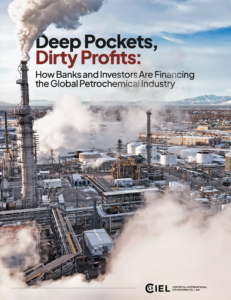
CIEL’s brief: Deep Pockets, Dirty Profits: How Banks and Investors Are Financing the Global Petrochemical Industry exposes the massive financial flows from banks and investors sustaining the top fifteen global petrochemical companies. By tracing these investments, the brief identifies who has been sustaining the industry and who is behind the next generation of fossil-based infrastructure. The brief provides much-needed data exposing how financial institutions are underwriting a toxic system that locks the world into fossil fuel dependence for decades to come.
Key Takeaways
The findings reveal that between January 2019 and June 2025, the fifteen largest petrochemical companies received over US$250 billion in sustained financing from 240 major global banks. The report identifies Citigroup (US), Bank of America (US), Mizuho Financial (Japan), JPMorgan Chase (US), HSBC (UK), Bank of China (China), Deutsche Bank (Germany), and Barclays (UK) as the primary financiers driving these investments.
The analysis also shows that financial exposure extends to institutional investors, with the top twenty investors holding over US$87 billion in petrochemical interests as of September 2025. This includes leading private asset managers such as Vanguard and BlackRock, as well as global public pension funds that manage the retirement savings of millions of individuals and workers. These include Norway’s Government Pension Fund Global (GPFG) and Japan’s Government Pension Investment Fund (GPIF).
The findings in CIEL’s brief are clear: despite increasing recognition of the industry’s health, climate, and environmental justice impacts worldwide, petrochemicals are deeply embedded in the portfolios of financial institutions that collectively shape the direction of the global economy. The vast scale of these investments is not only harmful to people and the planet — it is an escalating financial liability.
To address the social and environmental realities exposed in this brief, banks and institutional investors must:
- Immediately stop funding new petrochemical projects as well as financing for the expansion of existing facilities.
- Adopt a phased and time-bound approach to stop financing petrochemicals.
- Require petrochemical companies to develop and disclose comprehensive, just transition plans.
- Redirect capital towards strategic reinvestments.
Download the full ‘Deep Pockets, Dirty Profits Brief’ (PDF).
Explore the data in full at www.toxicfinance.org/global