
Financial Policy Cannot Be Separated from Climate Accountability
Published June 1, 2026
By Charles Slidders, Financial Strategies Manager and Senior Attorney, and Joie Chowdhury, Climate Justice and Accountability Manager and Senior Attorney, at the Center for International Environmental Law
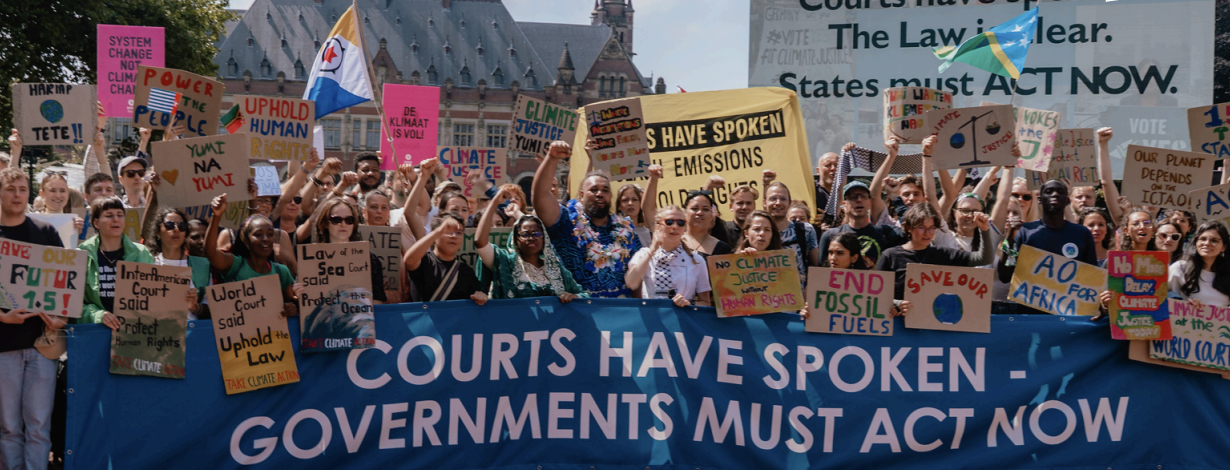
When the International Court of Justice (ICJ) declared in July 2025 that climate change is “an existential problem of planetary proportions,” it was not speaking only to diplomats. It was speaking to every State institution with the tools to help confront the climate crisis, including central banks.
In a sweeping Advisory Opinion, the ICJ affirmed that all States have existing legal duties to prevent and repair climate harm, and to protect the climate system by curbing planet-warming activities — chiefly fossil fuel production and use.
Momentum to act on the ICJ’s ruling is growing. On May 20, 2026, the United Nations General Assembly voted overwhelmingly in support of a climate accountability resolution to endorse and operationalize the Advisory Opinion, reaffirming States’ climate obligations.
Those obligations do not stop at environmental ministries. They extend to central banks and financial regulators whose decisions shape whether capital flows toward climate solutions or continues fueling destruction. That legal clarity places financial authorities at the center of climate accountability.
States Cannot Opt Out of Climate Action
The ICJ made clear that States’ obligations to prevent significant climate harm arise from multiple sources of international law — including customary international law, human rights law, environmental law, and climate treaties. In doing so, it dismantled a common misconception: climate obligations do not begin and end with climate treaties.
A State cannot escape its obligations, or the consequences of breaching them, simply by refusing to join or withdrawing from the Paris Agreement — as the United States recently did. No State, and no State institution, including central banks, can claim that climate action falls outside its mandate.
The Court confirmed that States can be held responsible not only for the climate harm they cause, but also for the harm they allow to happen. That includes failing to regulate private actors whose conduct would foreseeably contribute to serious environmental harm. Put simply, governments cannot avoid responsibility by outsourcing climate destruction to private markets.
And that responsibility has consequences. Where a State breaches its obligations — whether through action or inaction — it may be required to stop the wrongful conduct, provide assurances that it will not happen again, and provide full reparation for the harm caused.
Climate Obligations Apply to Central Banks
The ICJ reaffirmed a basic rule of international law: when a State organ or institution acts, the State acts. That includes central banks, whose decisions — including how they regulate and supervise financial markets — can be attributed to the State under international law.
Central banks must therefore ensure their policies align with States’ obligations to prevent climate harm. In practice, that means using the tools available to them — including monetary policy, capital regulation, collateral frameworks, and stress testing — in good faith and with due diligence to support mitigation efforts and help prevent foreseeable climate damage. A central bank’s failure to do so can carry consequences for the State under international law.
How Central Banks Can Help Prevent Climate Harm
Central banks exist primarily to safeguard economic and financial stability. Climate change is a “systemic risk” to both, with the potential to cause cascading financial failures that could trigger a major economic downturn. Central banks must therefore address climate-related systemic risk to protect economic and financial stability. That requires confronting fossil fuel emissions, the leading driver of the climate crisis.
The ICJ was explicit about the source of climate harm. It endorsed the scientific consensus that rising greenhouse gas (GHG) concentrations are driven primarily by human activity, including the burning of fossil fuels. It also clarified that States may breach international law when they fail to protect the climate system from GHG emissions, including by granting exploration licenses, providing fossil fuel subsidies, or enabling fossil fuel production and consumption.
Fossil fuel activities depend on capital. Through debt or equity, financial institutions enable the ongoing extraction and burning of fossil fuels that drive climate change. Central banks can help shift those financial flows. They can use monetary policy and capital regulation to encourage lending and investment toward “green assets,” like renewable energy, while discouraging continued investment in fossil fuel and carbon-intensive businesses.
Shifting Finance Toward Climate Solutions
The policy options are concrete. One option is adopting a green quantitative easing program that prioritizes the purchase of bonds, securities, and other assets designated “green,” with the aim of stimulating economic activity in the renewable energy sector. By channeling more money into real climate solutions, this approach may reduce the risk of climate-induced financial instability and help mitigate climate change.
Central banks can also adjust their collateral frameworks to make sustainable assets and climate adaptation projects eligible for refinancing. That can lower borrowing costs and expand credit for renewable energy businesses and climate-resilient infrastructure. Conversely, central banks could impose higher capital requirements on loans to firms with carbon-intensive economic activities, making it more expensive for those firms to borrow.
As climate devastation accelerates worldwide, the ICJ has made clear that States must take climate action or risk breaching their international legal obligations. Central banks are no exception. These State institutions influence whether capital keeps flowing to fossil fuel expansion or shifts toward climate solutions. Their choices can help States meet climate obligations — or expose States to responsibility for continued climate harm. Financial regulation is climate governance.